To enhance your browsing experience on our website, we utilize cookies. For more detailed information regarding our use of cookies, kindly refer to our privacy policy.
To enhance your browsing experience on our website, we utilize cookies. For more detailed information regarding our use of cookies, kindly refer to our privacy policy.


Posted On 2026-05-19
Author Shilpa Desai
Our payroll advisory team has reviewed 60+ CTC structures since November 2025. In 54 of them, the employer had no idea how much their total salary bill would increase under the new wage code - until we ran the numbers.
For some, it was a 4% cost increase. For a few, it was 11%. The difference? How badly their basic pay structure was gamed.
—-----------------------------------------------------------------------------------------------------------------
New Wage Code India: The 50% Rule That Is Reshaping Every Salary Structure
India’s four Labour Codes are being implemented in phases, with the timeline and applicability varying across states based on their respective notifications and preparedness. As different states progress at different speeds, businesses and employees should closely monitor local developments. Among the proposed changes, one of the most significant is the revised definition of “wages” and the associated 50% wage rule, which could have a direct impact on salary structures, provident fund contributions, gratuity calculations, and take-home pay once adopted in a particular state.
For updates on the implementation status of the Labour Codes across different states, readers can refer to the official resources published by the Ministry of Labour and Employment.
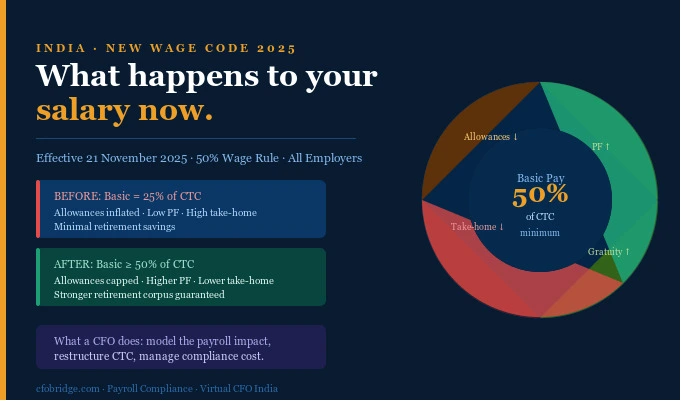
This is not a minor compliance tweak. It is a structural rebuild of how salaries are designed, how PF is calculated, and how much money actually lands in your account every month.
What Exactly Changed - The Old System vs the New
There was widespread confusion after November 2025 about whether every salaried employee in India would see an immediate drop in take-home salary. Here is the nuanced reality:
▌ FOR EMPLOYEES EARNING BELOW ₹15,000 BASIC PER MONTH
PF continues to be deducted at 12% on the statutory ceiling of ₹15,000 unless the employer and employee voluntarily opt for higher contributions. For this group, the take-home salary change is minimal or nil.
▌ FOR EMPLOYEES WITH HEAVILY LOADED ALLOWANCE STRUCTURES
If your current basic is only 25% of CTC - common in tech, media, and services - your employer must restructure. Basic goes up, taxable allowances come down. The net result: slightly lower take-home but significantly higher PF accumulation and gratuity payout over time.
▌ FOR EMPLOYERS
This is where the real cost hits. Higher basic = higher employer PF contribution (12% of the new, higher wage base), higher gratuity liability, and higher ESI contributions where applicable. For businesses with 100–500 employees, the cost impact can be material and must be modelled immediately.
What the 4 New Labour Codes Actually Cover
Code on Wages, 2019 - Uniform wage definition, minimum wages, payment timelines, overtime rules
Code on Social Security, 2020 - PF, ESIC, gratuity, maternity benefits; now extends to gig and fixed-term workers
Industrial Relations Code, 2020 - Hiring, layoffs, fixed-term employment, collective bargaining
Occupational Safety, Health and Working Conditions Code, 2020 - Working hours, leave, welfare, digital compliance
What Indian Businesses Must Do Right Now
Run a CTC simulation - map every employee's current basic % of CTC and identify employees who may require salary restructuring under the proposed wage definition
Model the cost delta - what does the increased employer PF and gratuity liability look like annually?
Revise offer letters, employment agreements, and HR policies to reflect new wage definitions
Update payroll software to calculate on the new wage base, not old basic
Classify contract, gig, and fixed-term workers correctly - they now have expanded rights
This is precisely the kind of structural payroll work that CFO Bridge's Virtual CFO Services team handles, helping businesses prepare for the implementation of the Labour Codes at the applicable state and entity level, so founders aren't blindsided by a compliance cost they never saw coming.
For businesses managing rapid hiring or complex payroll structures, our Financial Planning & Analysis service models the full cost impact of the new wage code across all employment levels.
The Income Tax Dimension - Often Overlooked
CA Dr Suresh Surana has noted that the restructuring of salary under the new wage code is likely to increase taxable salary for many employees. Here's why:
Many allowances that were previously tax-exempt - HRA, conveyance, medical - are often structured to sit outside the wage base. Under the new rules, excess allowances are added back into wages.
Higher basic salary may increase the taxable portion of salary, depending on the employee's salary structure and applicable tax provisions.
Higher PF contributions from both sides, however, increase deductions under Section 80C - partially offsetting the tax increase.
Useful External Resources
Ministry of Labour & Employment - New Labour Codes: labour.gov.in
EPFO - PF Contribution Rules: epfindia.gov.in
Income Tax Act Section 80C deductions: incometaxindia.gov.in
LawChakra - Labour Codes 2025 Analysis: lawchakra.in
Not automatically. The Labour Ministry has clarified that take-home salary will remain unchanged for most employees as long as PF is calculated on the statutory ceiling of ₹15,000 per month. Employees will see a reduction only if their employer voluntarily opts to contribute PF on the full wage base, or if their basic salary was significantly below 50% of CTC and is now being restructured upward.
Labour Codes are being implemented in phases. Their effective date depends on notifications issued by individual states and administrative readiness. The Code on Wages, 2019, which introduces the revised definition of wages and the associated 50% wage rule, is expected to have a significant impact on salary structures once implemented.
Under the new Labour Codes, fixed-term employees become eligible for gratuity after just one year of continuous service - down from the old five-year requirement. Additionally, since gratuity is now calculated on the expanded wage base (which is higher under the 50% rule), the payout is significantly larger than under old low-basic salary structures.
Business owners should immediately run a CTC simulation to identify employees whose salary structures may require revision to comply with the prescribed definition of wages once implemented, model the additional PF and gratuity liability this creates, update all employment agreements and payroll systems, and correctly reclassify gig, contract, and fixed-term workers under the new Code on Social Security. A Virtual CFO or payroll compliance consultant can manage this process end-to-end.


Answer a few questions and get matched with experts who’ve helped 500+ businesses like yours.
CEO Description
Here's a curated list of finance leaders for your industry and company size.
Finding your perfect CFO partners...


Our talented team will reach you out shortly.
Let's talk! Book your free consultation today


 India
India USA
USA UAE
UAE