To enhance your browsing experience on our website, we utilize cookies. For more detailed information regarding our use of cookies, kindly refer to our privacy policy.
To enhance your browsing experience on our website, we utilize cookies. For more detailed information regarding our use of cookies, kindly refer to our privacy policy.


Posted On 2026-06-09
Author Sachin Gokhale
▌ THE HOOK
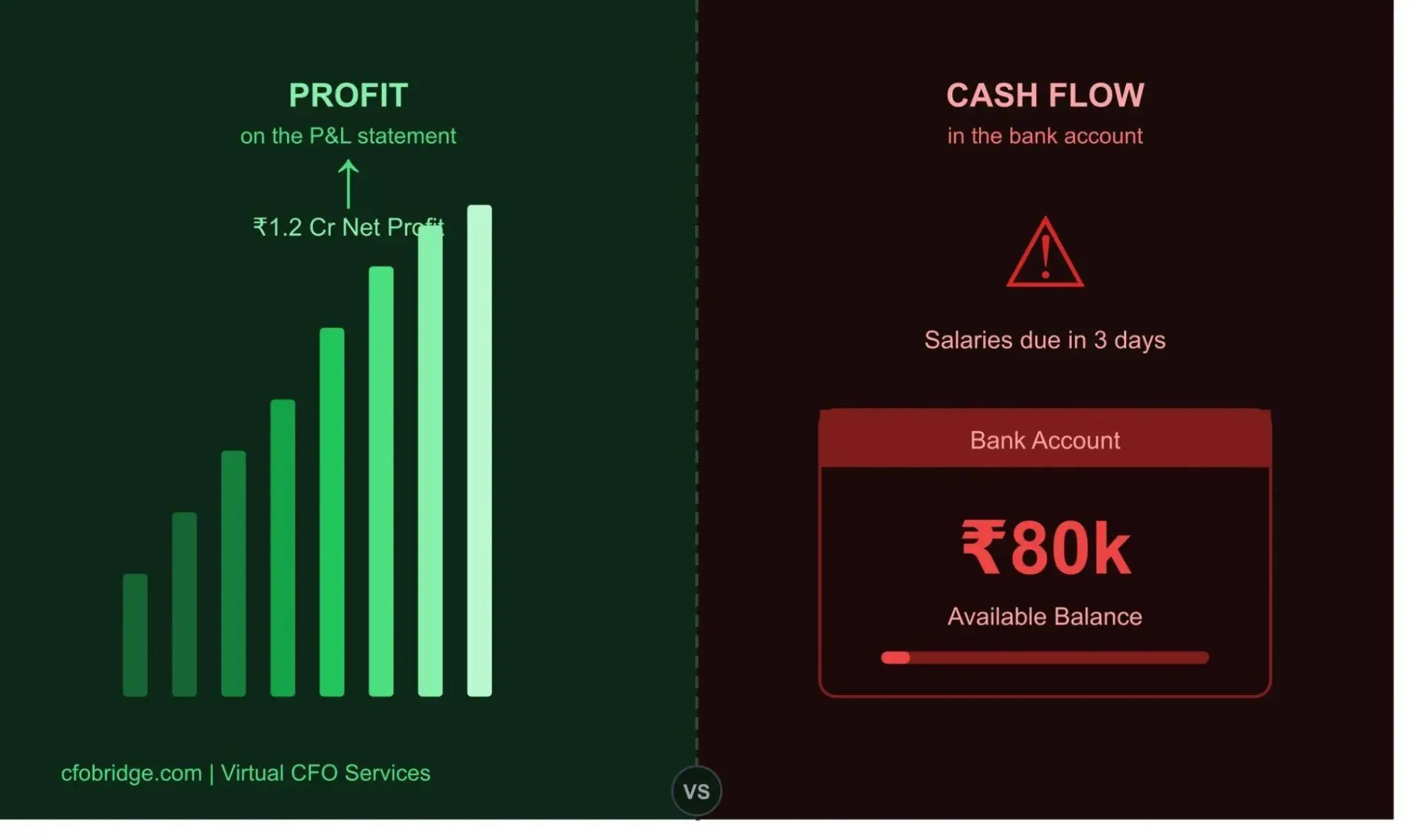
A Pune-based auto-components manufacturer reported ₹1.2 crore net profit in FY24. Six months later, they couldn't pay salaries.
They weren't lying. The profit was real. But the cash was gone - and nobody realised the difference until it was too late..
A founder sees ₹80,000 in the bank and wonders where the money went. The CA points to a profitable P&L. Both are right. The missing piece is understanding why profit doesn't always translate into cash.
Understanding the difference between cash flow vs profit in India is not accounting theory. It is survival.
It is also one of the least discussed problems in Indian business, because the P&L is the document everyone celebrates - at the board meeting, in the bank loan application, in the founder's own head. Cash flow, by contrast, lives in a bank statement nobody reviews with the same rigour. By the time a cash shortage becomes visible, it has usually been building quietly for two or three quarters.
Once this distinction is clear, the next question is why this gap is so much wider - and so much more dangerous - for Indian B2B companies specifically than for businesses elsewhere.
The Indian B2B credit culture creates a perfect storm:
Long payment terms (60–120 days) are standard in manufacturing, logistics, and pharma distribution
Customers delay without penalty - payment timelines are often difficult to enforce
Why this happens, from a CFO's perspective:
Bargaining power imbalance - Large buyers dictate terms to smaller suppliers who depend on the relationship for volume. MSMEs rarely enforce their legal right to penal interest, fearing loss of the account. Payment delays are largely caused by structural problems, such as lopsided buyer-supplier bargaining leverage, sluggish dispute settlement, and lax enforcement by central and state PSUs. SMB Connect
Weak enforcement mechanisms - Dispute resolution through MSME Samadhaan can take time, so few suppliers actually pursue claims, and buyers know this.
No real deterrent cost - Since penal interest is rarely invoked or collected, delaying payment becomes a de facto free source of working capital for large buyers - effectively an interest-free loan funded by their smaller vendors.
GST is paid at invoice, not receipt - so the government is paid before the customer is
Working capital loans from banks require collateral most MSMEs don't have
Each of these factors alone is manageable. Stacked together, they mean an Indian B2B company can grow revenue, win larger customers, and still watch its cash position deteriorate quarter after quarter - because growth itself is what widens the gap between the invoice date and the payment date.
This is why Financial Planning & Analysis is not a luxury for Indian B2B companies - it is foundational infrastructure.
The scenarios below are the four situations where we most often see profitable Indian companies get blindsided by a cash crisis they didn't see coming - not because the warning signs weren't there, but because nobody was tracking the right number.
▌ SCENARIO 1 - Rapid Growth
You win a ₹2 crore order. You spend ₹1.5 crore on materials and manpower. The customer pays in 90 days. You're profitable - but you've just created a 90-day cash gap.
On paper, this is a good problem to have - a big win, a happy customer, healthy margin. In practice, you now need to fund payroll, rent, and supplier payments for three months using cash you don't have yet, and the bigger the order, the bigger the gap. Growth without a matching cash plan is how healthy companies end up negotiating emergency credit lines at the worst possible time.
▌ SCENARIO 2 - Seasonal Demand
Festive season orders flood in. You invoice ₹3 crore in October. Payments arrive in January. Meanwhile, November and December salaries, rent, and supplier payments must be met.
The mismatch here isn't a one-off - it repeats every year, on the same calendar, and yet most businesses budget for it as if it were a surprise. A seasonal cash calendar, planned months in advance, turns a predictable dip into a non-event instead of an annual scramble for short-term funding.
▌ SCENARIO 3 - Customer Concentration
One client is 40% of your revenue. They delay payment. Your entire cash flow can buckle.
Customer concentration is a risk multiplier: it doesn't just affect one line item, it affects your entire cash position at once. A business with ten customers at 10% each can absorb one slow payer. A business with one customer at 40% has effectively handed that customer control over its cash flow, whether or not either side realises it.
▌ SCENARIO 4 - Under-priced Credit
You're profitable at 8% margin - but your cost of borrowing to bridge cash gaps is 14–18% from NBFCs. Profit disappears into interest costs.
This is the scenario that quietly erodes healthy businesses over several years rather than one bad quarter. The P&L keeps showing profit, so nobody raises the alarm - but the real return on the business is shrinking every year, because an increasing share of it is being paid out in interest to bridge gaps that better structured payment terms or cheaper financing could have avoided.
Builds a 13-week rolling cash flow forecast - the one of the most important documents in a business
Maps receivables by customer aging and flags concentration risk
Sets up early warning systems: when cash dips below X days of expenses, action triggers automatically
Restructures payment terms with key customers and vendors
Evaluates working capital financing options - invoice discounting, OD limits, CC limits - and recommends the lowest-cost option
Individually, each of these is straightforward finance discipline. Together, they shift a business from reacting to cash shortages after they happen to seeing them three to six months in advance - which is the difference between a planned conversation with a lender and an emergency one.
CFO Bridge's Virtual CFO Services include cash flow modelling as a core deliverable. We've seen businesses flip from 'chronically cash-tight' to 'cash-comfortable' within two quarters - without a single new rupee of revenue.
MCA India - Understanding Financial Statements: mca.gov.in
ICAI Guidance on Cash Flow Statements: icai.org
RBI Working Capital Study: RBI Publications
Yes - and it happens more often than founders realise. Profit is accrual-based: it records revenue when invoiced, not when cash is received. If a business invoices ₹5 crore but collects only ₹2 crore in a quarter, it may show profit on paper while facing a severe cash crisis.
Net profit is revenue minus all expenses on a P&L basis. Operating cash flow adjusts net profit for non-cash items (like depreciation) and changes in working capital (receivables, payables, inventory). Operating cash flow is a far better indicator of business health than net profit for day-to-day management.
B2C businesses collect cash at the point of sale. B2B businesses extend credit - often 60 to 120 days - to corporate customers. This structural credit gap, combined with India's weak invoice enforcement culture and GST upfront payment requirements, makes B2B cash management significantly more complex.
At minimum, monthly. High-growth or cash-tight businesses should review a 13-week rolling cash flow forecast every week. A Virtual CFO typically sets up automated MIS dashboards so founders can see their real cash position - not just P&L - at any time.


Answer a few questions and get matched with experts who’ve helped 500+ businesses like yours.
CEO Description
Here's a curated list of finance leaders for your industry and company size.
Finding your perfect CFO partners...


Our talented team will reach you out shortly.
Let's talk! Book your free consultation today


 India
India USA
USA UAE
UAE