To enhance your browsing experience on our website, we utilize cookies. For more detailed information regarding our use of cookies, kindly refer to our privacy policy.
To enhance your browsing experience on our website, we utilize cookies. For more detailed information regarding our use of cookies, kindly refer to our privacy policy.


Posted On 2026-06-12
Author Hitesh Kothari
▌ THE HOOK
A Series A SaaS founder in Bengaluru came to us after spending ₹18 lakhs annually on a financial advisor - and still couldn't answer: 'What's my runway?' or 'Can we afford to hire 10 engineers next quarter?'
The problem wasn't the advisor. The problem was using a ₹18 lakh hammer to knock in a CFO-shaped nail.
Most Indian founders conflate financial advisors, CAs, CFOs, and finance managers into one vague category called 'finance person'. This is expensive. Each role solves a different problem. One of the most common reasons growing Indian businesses struggle financially is bringing in the wrong financial expertise for the challenges they actually face.
The confusion is understandable - all four roles involve 'finance', all four cost money, and most founders have never had to hire any of them before. But the mistake is expensive in a specific way: it isn't just wasted budget; it's a business problem that keeps going unsolved because everyone assumes someone is already handling it. The Bengaluru founder above kept asking his financial advisor about runway for over a year before realising that was never a question the advisor was equipped to answer.
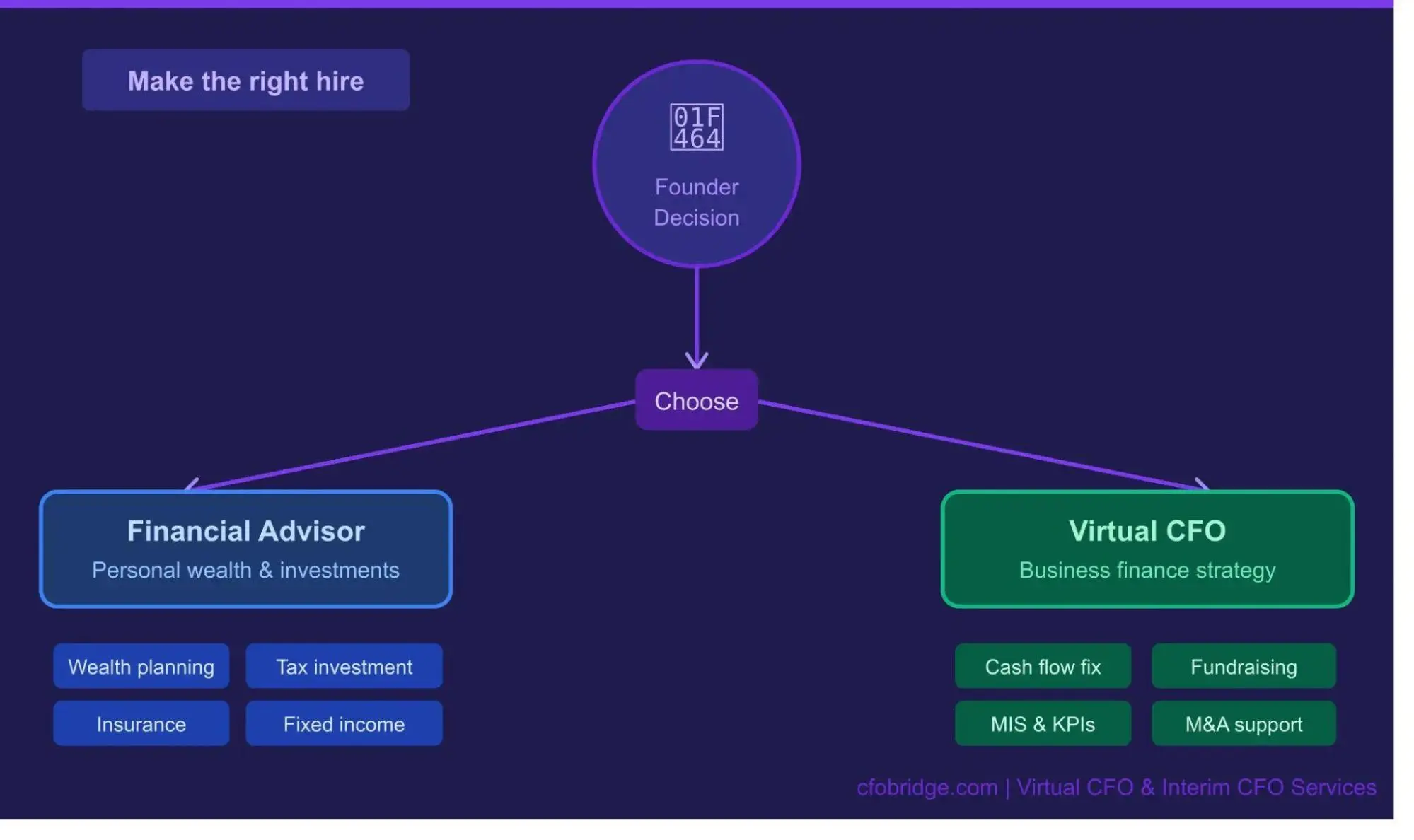
A financial advisor-whether a wealth manager, investment consultant, or independent financial planner-primarily focuses on helping individuals manage, protect, and grow their wealth. Their role typically includes:
Investing surplus cash in instruments such as mutual funds, bonds, fixed deposits, or other investment products
Personal wealth planning to help founders build, preserve, and transfer wealth over time
Structuring investments in a tax-efficient manner to optimise post-tax returns
Insurance planning to ensure adequate protection against financial risks through life, health, and other relevant insurance solutions
In short, a financial advisor helps you manage your personal finances and investments-not the day-to-day financial operations of your business.
This isn't a shortcoming of the advisor - it's simply outside their mandate. A good financial advisor can be genuinely valuable to a founder personally, especially once the business starts generating real surplus cash to invest. The problem only arises when a founder expects that same person to also run the finance function of the business itself.
Many business owners assume a financial advisor covers everything finance-related. In reality, they usually do not:
• Build operating financial models
• Manage cash flow and working capital
• Drive fundraising conversations with investors
• Set up MIS and performance dashboards
• Oversee audits or compliance requirements
This gap is exactly where growing Indian businesses get stuck. The founder has someone advising on personal investments, a CA filing returns and closing books, but nobody actually building the operating model, managing the cash position, or preparing the numbers a lender or investor will ask for. The business keeps growing on instinct, until the questions get harder than instinct can answer.
A Chief Financial Officer - whether full-time, fractional, or virtual - is the strategic finance leader for the business:
Financial planning, budgeting, and forecasting
Working capital and cash flow management
Fundraising strategy and investor relations
Business performance analysis and MIS
Risk management and internal controls
M&A, due diligence, and valuation
What ties these together is that a CFO is embedded in how the business actually runs - not advising from outside it. A CFO sits in the same conversations as the CEO about pricing, hiring, and expansion, and translates those decisions into what they mean for cash, runway, and risk. That's a fundamentally different relationship than an advisor who reviews your portfolio once a quarter.
CFO Bridge's Interim CFO Services and Virtual CFO Services are built for exactly this: founders who need senior CFO thinking without the ₹60–80 lakh full-time salary.
The table below is a quick way to determine which category your current need actually falls into - before you sign a retainer with the wrong kind of finance professional.
▌ STAGE 1 - ₹0 to ₹2 Crore Revenue
A good CA handles compliance. A financial advisor manages founder wealth. No CFO needed yet.
The temptation at this stage is to over-hire - bringing in a CFO before there's enough financial complexity to justify the cost. A capable CA plus disciplined founder-level tracking of cash and margins is usually sufficient until the business crosses roughly ₹2 crore in revenue.
▌ STAGE 2 - ₹2 to ₹15 Crore Revenue
This is the stage where countless Indian businesses hit a growth wall. They have complexity but not the finance infrastructure to manage it. A Virtual CFO at ₹50,000–₹1.5 lakh per month delivers 80% of a full-time CFO's value.
This is also the stage where the cost of getting the hire wrong is highest, because the business now has enough moving parts - multiple product lines, growing headcount, working capital swings - that finance mistakes compound quickly, but not yet enough scale to justify a ₹50-80 lakh full-time CFO salary. A Virtual CFO engagement is built precisely for this gap: senior-level financial judgment, sized to the stage.
▌ STAGE 3 - ₹15 Crore+ or Pre-Fundraise
A full-time CFO or a senior fractional arrangement through CFO Bridge becomes essential. At this stage, the CFO is the second most important hire after the CEO.
By this stage, the questions a business needs answered - unit economics by product line, scenario planning for a fundraise, board-ready MIS, due diligence readiness - are no longer things a part-time or junior resource can credibly own. The cost of not having this in place shows up later, usually in a due diligence process or investor conversation, at the worst possible time to discover a gap.
SEBI Registered Investment Advisors List: sebi.gov.in/RIA
ICAI on CFO Roles in India: icai.org
MCA - Companies Act provisions on CFOs: mca.gov.in
No. A financial advisor typically manages investments and personal wealth planning. A Virtual CFO manages the business's financial operations - cash flow, budgeting, MIS, fundraising, and strategic planning. For a growing Indian business, these are fundamentally different functions.
Most businesses benefit from a Virtual or Fractional CFO once revenue crosses ₹3–5 crore. At this stage, financial complexity - GST, payroll, working capital, bank relationships, compliance - outpaces what a CA alone can manage strategically. A CFO brings the planning and forecasting layer that a CA typically does not.
A full-time CFO in India typically costs ₹40–80 lakh per year in total compensation. A Virtual CFO through services like CFO Bridge typically costs ₹50,000–₹2 lakh per month depending on scope - delivering senior CFO capability at 20–30% of the full-time cost.
A CA primarily handles compliance, audit, and taxation. A CFO handles strategy, forecasting, investor relations, and financial architecture. While some senior CAs operate as de facto CFOs, the roles are distinct. As a business scales, the strategic finance gap that only a true CFO fills becomes increasingly critical to growth.


Answer a few questions and get matched with experts who’ve helped 500+ businesses like yours.
CEO Description
Here's a curated list of finance leaders for your industry and company size.
Finding your perfect CFO partners...


Our talented team will reach you out shortly.
Let's talk! Book your free consultation today


 India
India USA
USA UAE
UAE