To enhance your browsing experience on our website, we utilize cookies. For more detailed information regarding our use of cookies, kindly refer to our privacy policy.
To enhance your browsing experience on our website, we utilize cookies. For more detailed information regarding our use of cookies, kindly refer to our privacy policy.


Posted On 2026-06-15
Author Hitesh Kothari
▌ THE HOOK
We ran a receivables audit for a mid-sized Mumbai logistics firm. They had ₹2.3 crore sitting in invoices older than 90 days. Three of those customers had placed fresh orders in the same period - and the sales team had accepted them without flagging the overdue amounts.
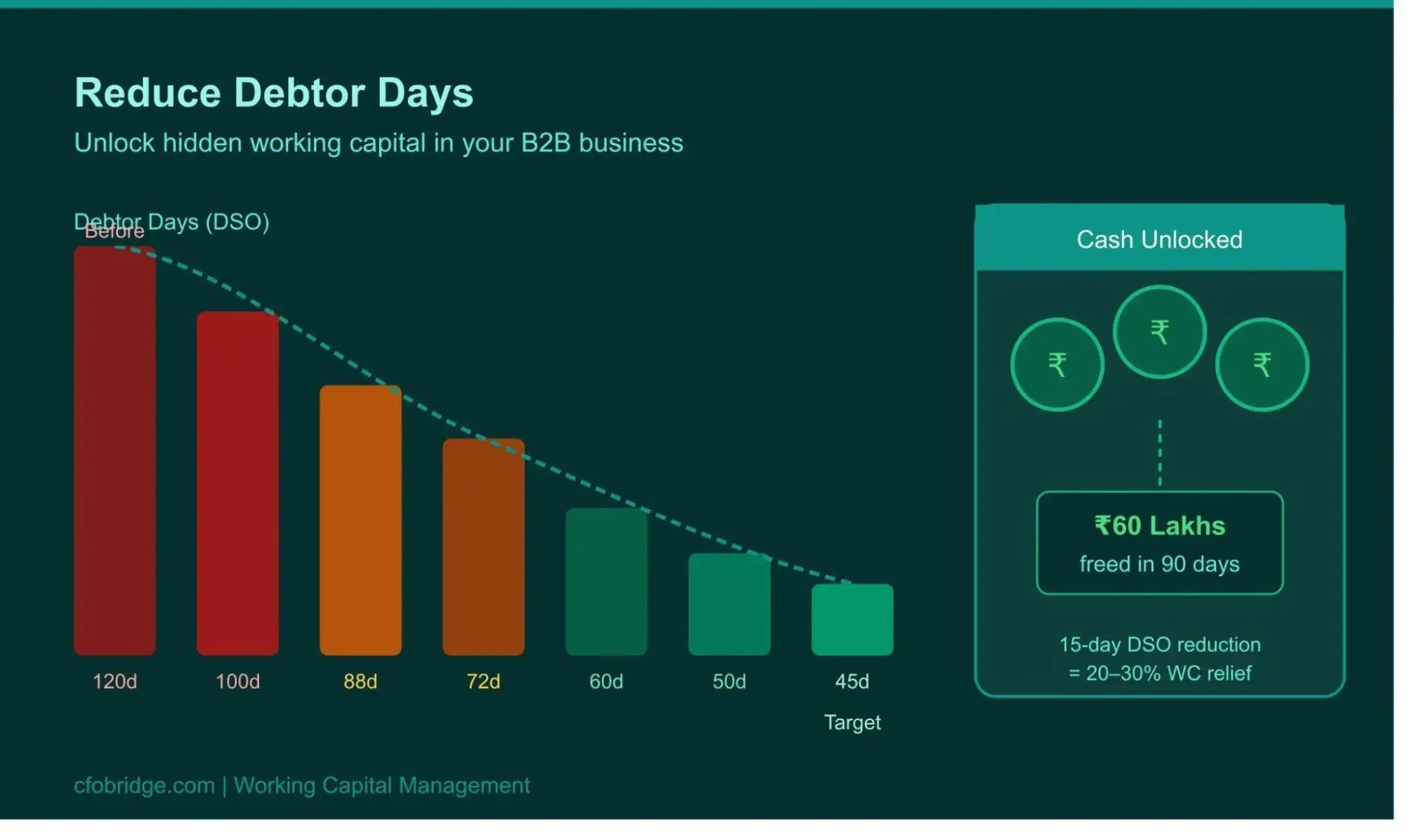
Reducing debtor days by just 15 days freed up ₹60 lakhs in operating cash - without a single new sale.
Every invoice starts a clock. Debtor Days (DSO) tracks how long that clock runs before cash reaches your bank account. In India’s B2B ecosystem, that wait is commonly 60–90 days-and for many MSMEs, it extends far beyond 120 days.
A rising DSO is more than a collection metric-it's cash trapped outside your business. The good news is that there are proven ways to bring it back faster.
This isn't a challenge unique to a handful of sectors. Manufacturing, logistics, IT services, and pharma distribution all run on B2B credit, which means almost every growing Indian company eventually hits the same wall: strong order books, healthy margins on paper, and a bank balance that doesn't reflect either. The businesses that recover fastest are the ones that treat DSO as a board-level metric from day one, not a problem they discover only after a cash crunch forces the issue.
Review this calculation monthly or at least quarterly. If your Debtor Days (DSO) is rising, it's an early warning signal - not an accounting footnote.
DSO measures the average time customers take to pay after receiving an invoice. A rising DSO means more cash is getting locked in receivables, putting increasing pressure on your working capital and cash flow.
A single quarterly snapshot only tells you where you stand today. What actually matters is the trend line. A company sitting at 55 days but climbing steadily from 40 days two quarters ago has a bigger problem than one that has been stable at 65 days for a year. Track DSO alongside revenue growth - if receivables are growing faster than sales, you are financing your customers' businesses with your own working capital, and every new order is quietly making your cash position worse, not better.
Not all overdue invoices are equal. A 65-day invoice from a reliable customer is a different risk from a 65-day invoice from a customer who has disputed the quality. Build a receivables aging ladder:
The purpose of this ladder isn't just visibility - it's forcing a different conversation at each stage. An invoice in the 0-30 day bucket needs a system, not a person. An invoice sitting at 90+ days needs a decision-maker, because by that point the issue is rarely about the invoice; it's about whether the relationship, the product, or the customer's own cash position is the real problem. Most Indian MSMEs lose money not because they lack a collections process, but because every aging bucket gets the same polite follow-up email regardless of risk.
▌ ROOT CAUSE 1 - No Clear Payment Terms in Contracts
Most Indian B2B agreements are verbal or in email. If payment terms only exist in conversations, they're difficult to enforce when delays happen. Put them in writing-every contract, every PO acceptance, and every invoice should clearly define payment timelines.
This gap costs more than most founders realise. Without a written due date, 'net 30' becomes whatever the customer's accounts team decides it means that month, and there's no paper trail to escalate a dispute, invoke penal interest under the MSME Development Act, or even prove when the payment obligation began. A one-line payment clause on every PO and invoice - due date, penal interest rate, and dispute window - closes this gap at zero cost.
▌ ROOT CAUSE 2 - Invoice Disputes
Customers delay payment citing invoice errors - wrong GST number, PO number mismatch, delivery discrepancy. Fix: implement a pre-invoice checklist.
CFO Bridge's clients follow a standardized 7-point invoice verification protocol that ensures invoices are accurate, complete, and approved before submission. By eliminating common errors and disputes upfront, they have reduced payment delays caused by invoice discrepancies by up to 60%.
The pattern is almost always the same: the same three or four errors repeat across hundreds of invoices because nobody owns the check before the invoice goes out the door. A pre-invoice checklist that verifies GST details, PO number, quantity, and rate against the original order - before the invoice is emailed - removes the single most common excuse customers use to justify a delay.
▌ ROOT CAUSE 3 - No Formal Collections Process
Most MSMEs send one reminder and then wait. A structured collections cadence looks like this:
The cadence works because it removes ambiguity about who acts and when - nobody is guessing whether it's 'too early' to follow up or waiting for someone else to make the call.
Day 1 of due date: automated email reminder
Day 3: WhatsApp/call from accounts team
Day 7: escalation to sales relationship manager
Day 15: senior management or CFO call
Day 30: formal notice + order hold
Discipline matters more than the exact timeline. A cadence that exists only on paper and is abandoned the moment a sales relationship feels awkward will not move your DSO. The businesses that see results assign clear ownership for each stage and track adherence to the cadence itself, not just the final collection outcome.
▌ ROOT CAUSE 4 - Accepting New Orders from Overdue Customers
The biggest risk often comes from selling more to customers who haven't paid for previous orders. Sales teams do it to protect the relationship, but it can worsen cash flow problems.
A CFO institutes a credit limit policy: no new orders above X value unless receivables are current.
Enforcing this consistently is harder than writing the policy. Sales teams are measured on bookings, not collections, so without a CFO or finance function empowered to hold or flag an order, the policy quietly erodes the first time a large customer pushes back. The businesses that make this work route every new order above the threshold through a two-minute credit check before confirmation - not after dispatch.
Early Payment Discounts: Offer 1–2% discount for payment within 10 days. For a ₹1 crore invoice, ₹1 lakh discount is a small price to get ₹99 lakhs 60 days earlier.
TReDS (Trade Receivables Discounting System): Monetise invoices from MSME-registered buyers. Learn more about TReDS.
Invoice Factoring via NBFCs: Sell your receivables at a small discount to get cash immediately. Useful for large, one-off invoices.
None of these tools are a substitute for fixing the root causes above - they're a bridge while you do. Used well, they buy you time and cash without taking on expensive short-term debt; used as a permanent crutch, they simply mask a collections problem that keeps getting larger. The right mix depends on your margin, your customer concentration, and how much of your receivables book is genuinely collectible versus structurally at risk - which is exactly the kind of judgment call a CFO is meant to make.
In our work with 500+ Indian businesses, we've found that reducing debtor days by 20 days is one of the highest-ROI interventions available to most B2B MSMEs. Here's what our CFO teams implement:
These aren't abstract best practices - they're the specific, unglamorous systems that turn a vague instruction like 'chase the overdue accounts' into a repeatable, measurable process that survives a change in accounts staff or a difficult sales conversation.
Receivables aging dashboard built in Excel or Tally - updated weekly
Customer credit scoring model - each client gets a credit limit based on payment history
Collections SOP with clear ownership between sales, accounts, and management
Working capital financing evaluation - is invoice discounting cheaper than your current OD rate?
Monthly debtor days KPI tracked in board-level MIS
This work sits at the core of CFO Bridge's Working Capital Management and Financial Planning & Analysis services.
RBI Guidelines on MSME Payments: rbi.org.in
MSME Samadhaan - Delayed Payment Portal: msmesamadhaan.gov.in
TReDS Platforms in India - RXIL, M1xchange, A.TREDS: RBI Approved TReDS
For most Indian B2B sectors, a DSO below 45 days is considered healthy. Manufacturing businesses typically runs 60–75 days due to industry norms. If your DSO exceeds 90 days, it signals a systemic collections problem that requires immediate CFO-level intervention, not just better follow-up emails.
Yes, when structured correctly. A 1–1.5% discount for payment within 10 days (2/10 Net 30 terms) effectively converts a 30-day invoice to a 10-day collection. The cost of the discount is almost always lower than the cost of working capital borrowing to bridge the gap - making it a net positive for cash flow.
MSME Samadhaan is a government portal that allows MSME-registered businesses to file a complaint against buyers (including large corporates and PSUs) who delay payment beyond 45 days. The Micro and Small Enterprise Facilitation Council (MSEFC) then facilitates resolution. It is a low-cost, legally backed mechanism that most Indian MSMEs are unaware of.
Invoice discounting allows you to borrow against unpaid invoices while retaining control of collections - your customer does not know you've financed the invoice. Factoring involves selling the invoice to a third party who then collects payment directly from your customer. Factoring is more expensive but suitable when you lack a collections infrastructure. A CFO can advise on which option suits your customer relationships and cash flow needs.


Answer a few questions and get matched with experts who’ve helped 500+ businesses like yours.
CEO Description
Here's a curated list of finance leaders for your industry and company size.
Finding your perfect CFO partners...


Our talented team will reach you out shortly.
Let's talk! Book your free consultation today


 India
India USA
USA UAE
UAE