To enhance your browsing experience on our website, we utilize cookies. For more detailed information regarding our use of cookies, kindly refer to our privacy policy.
To enhance your browsing experience on our website, we utilize cookies. For more detailed information regarding our use of cookies, kindly refer to our privacy policy.


Posted On 2026-06-05
Author Hitesh Kothari
▌ THE HOOK
We audited 47 Indian MSME balance sheets last year. In 38 of them, the business was profitable on paper - and cash-starved in reality.
The culprit? A broken working capital cycle that no one had mapped, let alone fixed.
You invoice your customer. You wait 60, 90, sometimes 120 days to get paid. Meanwhile, your supplier wants payment in 30 days. Your salaries are due on the 1st. Your GST filing lands on the 20th.
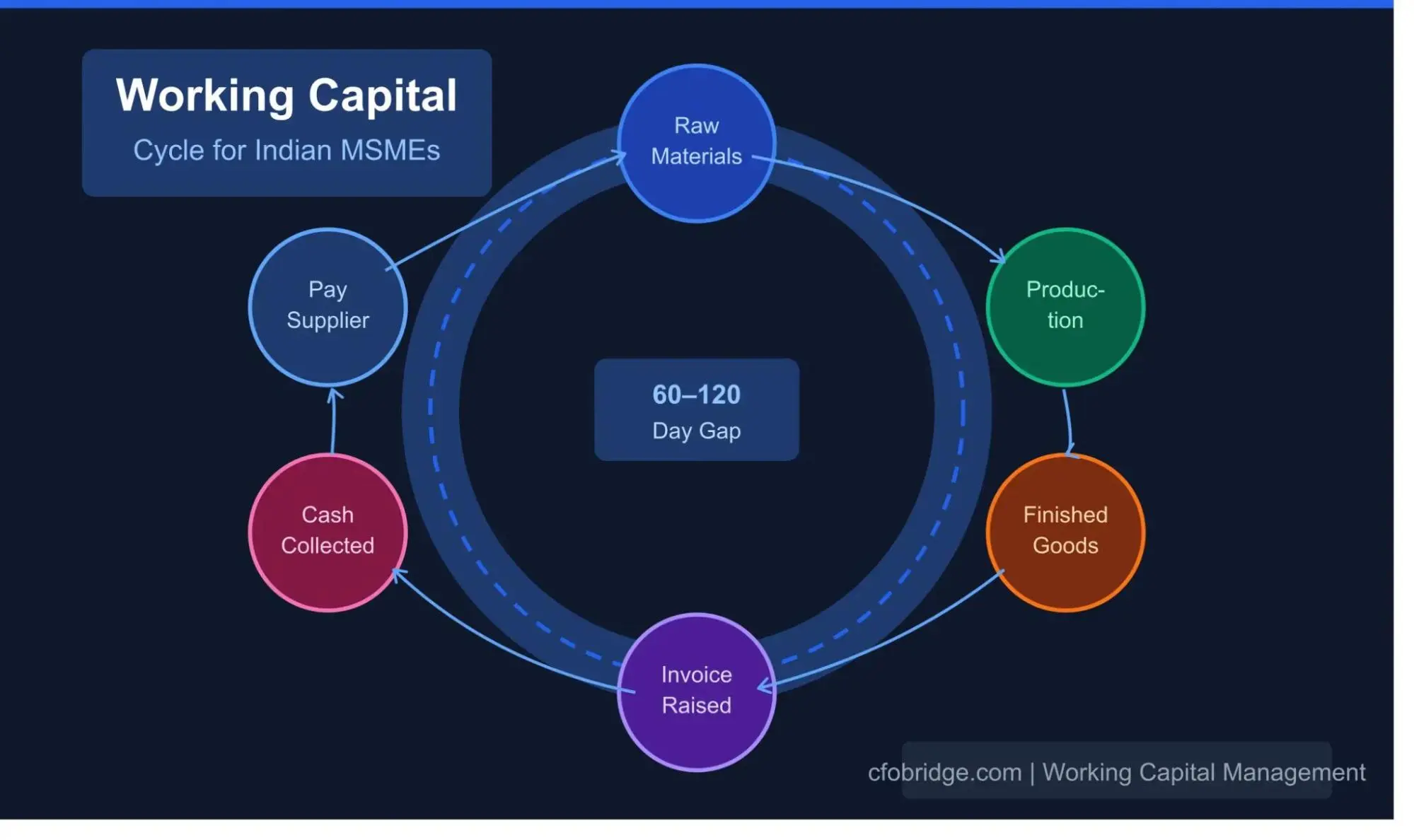
At its core, the working capital cycle is the period between spending money and recovering it through sales. When this cycle stretches too long, it can place significant financial pressure on Indian MSMEs.
The challenge isn't that the business isn't making money; it's that cash isn't arriving when it is needed.
Raw material purchase → payment made immediately or within 30 days
Goods manufactured → 10–20 days
Goods delivered → invoice raised
Customer pays → 60–120 days later
That means you could be funding 100–150 days of operations from your own pocket before a single rupee returns. The longer this cycle, the more working capital you need to keep the business running.
If your cycle keeps stretching, it isn't poor sales - it's poor cash architecture. This is exactly what CFO Bridge addresses through its Working Capital Management service.
▌ STAGE 1 - Inventory Pileup
Most MSME owners over-purchase raw materials to 'avoid stockouts.' The result: cash locked in warehouses. Best practice is to target a Days Inventory Outstanding (DIO) below 30 for most industries as benchmarks vary within industry-to-industry.
▌ STAGE 2 - Receivables Creep
One large customer delays payment. You don't chase them because you fear losing the relationship. Then two more follow. Before you know it, ₹40 lakhs is sitting in your debtors' ledger doing nothing. As a general benchmark, aim for a Debtor Days ratio below 45 for healthy B2B operations.
▌ STAGE 3 - Payables Mismatch
You're paying your vendors in 30 days but collecting from customers in 90. Negotiating even a 15-day extension in payment terms, can free up substantial working capital and improve cash flow.
A CA or bookkeeper records what happened. A CFO fixes what's happening - and prevents what will happen next.
Step 1: Map the full cycle - DIO + DSO + DPO. Most founders have never seen this number for their business.
Step 2: Segment receivables by customer aging. Who owes you what, and for how long? A CFO builds a 60/90/120+ day aging ladder.
Step 3: Renegotiate payment terms. A CFO with credibility can push vendor credit from 30 to 45 or 60 days without damaging relationships.
Step 4: Introduce invoice discounting or MSME factoring to monetize receivables without waiting.
Step 5: Build a 13-week cash flow forecast so you can identify cash shortfalls before they occur.
CFO Bridge's Virtual CFO Services teams typically reduce a client's working capital cycle by 20–35 days within the first two quarters. That can translate into lakhs of rupees in released working capital—without generating additional revenue.
RBI's MSME Credit Report: Reserve Bank of India MSME Publications
SIDBI MSME Pulse (working capital data): sidbi.in
Trade Receivables Discounting System (TReDS): RBI TReDS Framework
A healthy working capital cycle for most Indian B2B MSMEs is under 60 days. Manufacturing businesses may run 75–90 days due to inventory needs. If your cycle exceeds 100 days, it signals structural cash flow risk that requires immediate intervention.
GST requires businesses to pay tax on invoices raised - not on cash received. This means you often fund the government's GST while waiting 60–90 days for your customer to pay. Proper GST cash flow planning, typically done by a Virtual CFO, can prevent this from becoming a liquidity trap.
Yes. Platforms like TReDS (Trade Receivables Discounting System) and NBFC-backed factoring allow Indian MSMEs to monetise their invoices at a small discount rate - often 1–2% per month - instead of waiting 90 days for payment. A CFO can evaluate the cost-benefit and set up the facility
Working capital management focuses on optimising the cycle of inventory, receivables, and payables - the structural levers. Cash flow management is the real-time monitoring and forecasting of cash in and out. A strong finance function needs both: a CFO handles the structural fixes while building the forecasting infrastructure.


Answer a few questions and get matched with experts who’ve helped 500+ businesses like yours.
CEO Description
Here's a curated list of finance leaders for your industry and company size.
Finding your perfect CFO partners...


Our talented team will reach you out shortly.
Let's talk! Book your free consultation today


 India
India USA
USA UAE
UAE